
Integrated Environmental Tax Data Systems (IETDS). Public Data Governance and Interoperability for Latin America

1. Introduction: Real-time governance.
The current climate crisis, which we are seeing accelerate with unprecedented frequency and intensity, demands that governmental responses evolve from a reactive approach toward proactive environmental governance implemented in real time.
This transformation is not optional; without precise and dynamic control over economic activity and its ecological impact, mitigation efforts lose their effectiveness. However, this imperative faces a major obstacle: the absence of a comprehensive digital governance framework that transcends the traditional vision.
Real-time data governance is now well established in the financial and tax sectors, but this model has not yet been extended to environmental governance. Over the past two decades, governments around the world—and particularly in Latin America—have made significant investments in the digitalization of tax administration through systems such as electronic invoicing, digital customs declarations, and real-time reporting.
Although these technologies were designed for tax purposes (tax collection, reducing compliance costs, and combating fraud), the verified transactional infrastructure that underpins them represents the most valuable source of real-time economic intelligence available to governments.
We pose a fundamental question: Can this same infrastructure support environmental governance and sustainable economic planning? The answer is yes; through the concept we call Integrated Tax-Environmental Data Systems (IETDS).
An IETDS is a governance model in which selected environmental metadata are securely incorporated into existing digital transactional flows and shared with authorized public institutions under strict legal safeguards. Implementing it is not a simple administrative or technical decision. It requires a government mandate that defines data interoperability as a cross-cutting public good, elevating digital governance to a strategic policy.
2. ETDS perspective and the “One-Time” Model”.
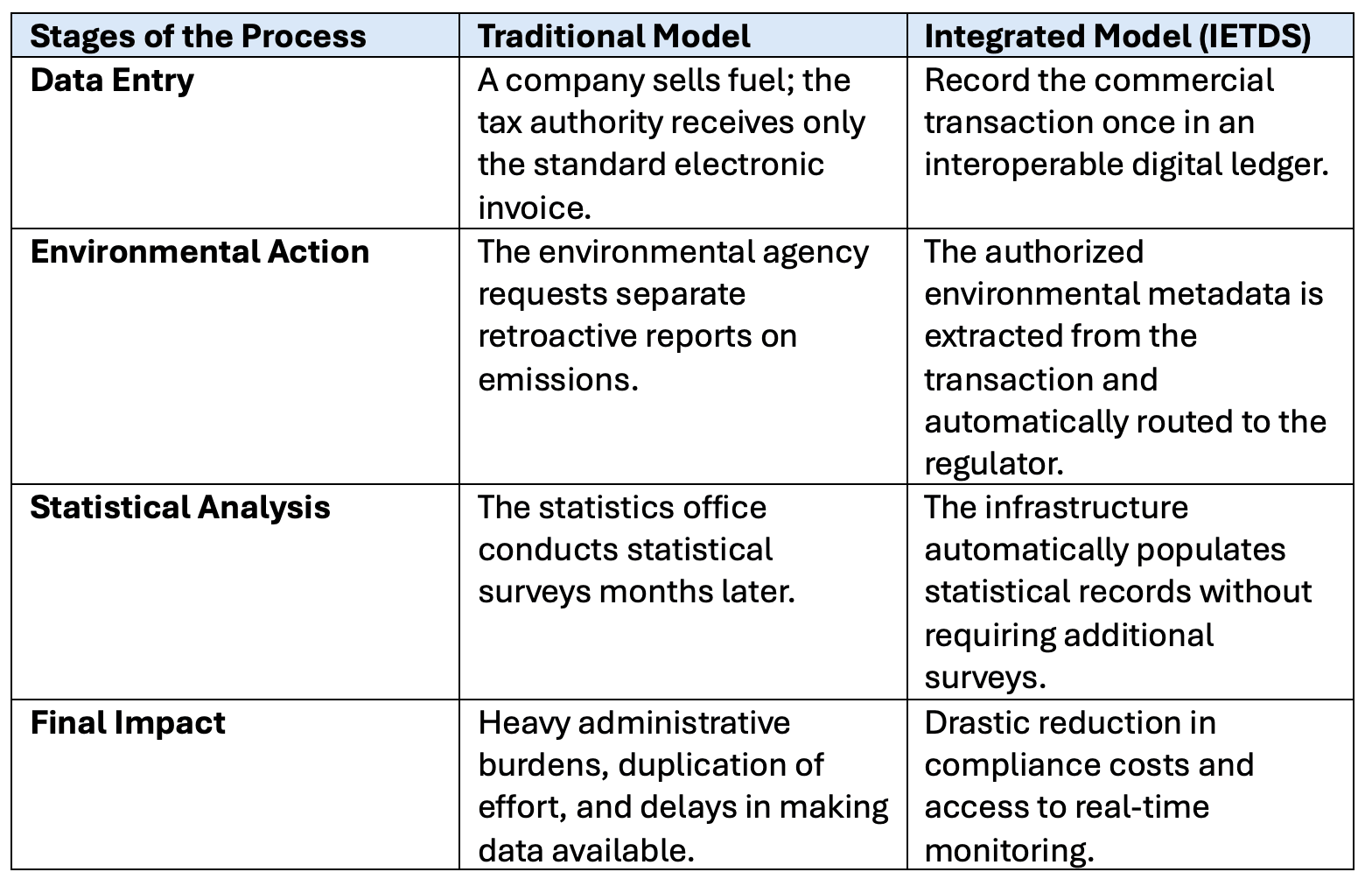
The primary objective of an IETDS is not to create new reporting burdens for the private sector, but rather to eliminate systemic duplication and simplify regulatory compliance. Under the traditional model, companies submit overlapping information to multiple agencies in isolation:
- Tax and Customs authorities: Financial and business data.
- Environmental agencies: Independent reports on emissions and resource use.
- Statistical offices: Supplementary Periodic Surveys.
A Shared Data Model would remove this fragmentation under the operational principle of “ Collect once, verify once, and safely reuse many times “. Key metadata on products, inputs, energy use, transportation, and environmental impact are directly integrated into the primary transaction record (e.g., electronic invoice). This approach finds its most advanced practical validation in Estonia’s e-governance framework. Through its distributed data layer (X-Road), Estonia proved that public databases do not need to be centralized to be fully interoperable, establishing the “Once-Only Principle” where citizens and businesses never have to provide the same information to a public authority twice. This state-level pioneer inspired the European Union, which has since elevated the Once-Only Principle (OOP) and the Single Digital Gateway regulation into mandatory standards for digital public administration across member states model.
Comparative Matrix of Workflows
Evolution of technological governance
The IETDS represents the third generation in the evolution of digital invoicing:
- Generation 1 (Digitalization): Converting paper documents to electronic files.
- Generation 2 (Tax Compliance): Introduction of structured formats (XML) and real-time reporting to tax authorities.
- Generation 3 (Public Data Interoperability): Transforming transactional systems into national data infrastructure, while simultaneously optimizing tax compliance, climate metrics, circular economy tracking, and public safety.
3. Institutional Barriers and the Economics of Digital Compliance
Why is interoperability not implemented yet? The barriers are not related to calculations or technology, but rather are institutional, legal, and historical: We can point to historical specialization: Tax administrations and environmental authorities have evolved with distinct organizational cultures, isolated regulatory frameworks, and IT systems. Furthermore, the regulatory frameworks for environmental laws were designed before the era of electronic invoicing, relying on self-reporting and physical inspections, as well as international conventions that require specific reporting formats.
On the part of tax authorities, strict confidentiality requirements: The rules on tax secrecy are often interpreted inflexibly, preventing secure inter-agency data exchange. Similarly, misaligned identifiers: The lack of a unique corporate identification number across tax, customs, and environmental authorities prevents automatic data matching.
Failure of Economic Coordination and the Digital Governance Gap
There is often a deficient structural coordination between the public and private sectors, with the lack of a comprehensive national digital governance strategy as main obstacle. While real-time data governance is already well established in the financial and fiscal sectors, it does not extend to environmental governance.
The tax administrations lack a mandate to adapt their infrastructure for other governance purposes, while the ministry of environment is unable to deploy a real-time tracking network without in part duplicating the tax authority’s infrastructure. For its part, the private sector faces growing compliance fatigue and costs when operating within fragmented reporting systems. Overcoming this barrier is not simply a matter of administrative adjustments, but rather a high-level political decision that defines data interoperability as a strategic public good.
4. Governance and Safeguards for Data Trust
To ensure the viability of an integrated system without compromising corporate rights or confidentiality, the system should be structured with multiple layers of protection:
- Tax Confidentiality: Environmental agencies would not have access to tax records, but only to environmental metadata authorized by law, and applied strictly to B2B relevant transactions.
- Role-Based Access Control: Different permissions for tax auditors, environmental regulators, customs officials, and statistics offices.
- Federated Data Architecture: It avoids the creation of a large, centralized database; the information remains in the custody of the originating institution and is interconnected via secure protocols, thereby reducing cybersecurity risks.
- Traceability and Audit Trails: Automatic logging of who accessed which data, the date, and the purpose. Involvement of data protection authorities and digital governance committees
- Cybersecurity: End-to-end encryption, multi-factor authentication, and regular audits. (mirroring Estonia’s robust defense mechanisms, such as decentralized data embassies and cryptographic timestamping, which have proven highly resilient against persistent cyberattacks).
5. International Trade and the Nomenclature Dialogue: CBAM
The development of an IETDS has become a business necessity due to global policies such as the European Union’s Carbon Border Adjustment Mechanism (CBAM). Under the CBAM, tariffs and penalties are not calculated based on what the product is, but rather on how it was manufactured (its embedded carbon).
The Harmonized System (HS) Gap
The Harmonized System (HS) Code traditionally used by international customs authorities classifies goods based on their physical characteristics, but it is “blind” to their environmental impact. A standard HS code does not allow for differentiation between green steel produced using clean energy and steel with a high carbon footprint.
The use of IETDS could link the national electronic invoicing system with customs records. By recording the carbon footprint at the source of the commercial transaction, the emissions profile of exports is automatically verified. Customs authorities at the destination can access this verifiable data in real time, eliminating the need for paper certifications, retroactive estimates, and border disputes.
6. Conclusion and Strategic Opportunity
The expansion of electronic invoicing, the Digital Public Infrastructure (DPI), cloud computing, and real-time analytics offer an unprecedented opportunity to replace document-based governance with data-centric digital ecosystems. The challenge for decision-makers is not the technological capacity to collect information, but rather the redesign of the regulatory framework so that a single verified transaction simultaneously supports fiscal integrity, environmental sustainability, public health, and economic resilience.
Convergent Policy Frameworks and References:
- OECD (2024). Recommendation of the Council on the Adoption of the Once-Only Principle. Public Governance Policy Papers.
- e-Estonia Briefing Centre (2025). X-Road Architecture and Interoperability Standards for Public Data Exchange
- World Bank Group (2025). Digital Public Infrastructure and Development: A World Bank Group Approach.
- Barreix, A., et al. (CIAT, 2025). Factura electrónica: la innovación latinoamericana de alcance global.
- European Commission (2023–2026). CBAM Guidance and Carbon Traceability Frameworks for International Trade.
1,647 total views, 4 views today