
The direct taxation of crypto-assets. A challenge for tax administrations

The expansion of crypto-assets as an investment class and as a means of payment has indeed forced tax administrations around the world to frame a new economic reality into pre-existing legal categories, designed decades ago for assets with physical support or, at least, those with an identifiable geographical location.
Each jurisdiction has gradually determined, with a greater or lesser degree of regulatory development, how the purchase and sale, exchange, staking, mining, the airdrops, or the simple holding of these assets are taxed. Theses answers diverge markedly even between countries with close legal traditions and tax systems.
This lack of uniformity in the direct taxation of crypto-assets is what motivated me to write this post, also pointing out the main pending challenges that will surely influence tax administration management.
First of all, it is worth focusing on three features that explain why the direct taxation of crypto-assets poses specific problems, different from those presented by other financial or intangible assets.
First, decentralization. Since crypto-assets are not issued or backed by any central bank or public authority, and their ledger is maintained in a distributed manner among the nodes of a network, there is no central entity that can automatically report to tax administrations, as is the case with traditional financial institutions.
Second, native transnationality. The same transaction can be initiated, executed, and settled without ever involving a party established in the taxpayer’s country of residence, which makes it extremely difficult to apply the traditional criteria of territoriality and the location of the source of income.
Third, the functional heterogeneity of the category itself. Under the label “crypto-asset” instruments with radically different economic functions coexist, such as means of payment, investment instruments, utility tokens, or representations of physical or digital assets. This prevents, in principle, the application of a single, cross-cutting taxation rule.
These three factors explain why most countries have opted for a pragmatic approach by applying existing rules for assets of a similar nature to crypto-assets, by analogy, instead of approving an entirely new and autonomous tax regime.
While this option has the advantage of continuity and the relative legal certainty provided by relying on already consolidated concepts, it undoubtedly transfers the burden of deciding, case by case, with which traditional framework matches each specific operation onto to the interpreter, taxpayer, advisor, or tax administration.
In this sense, it should not be forgotten that the legal nature of crypto-assets can be a determining factor in their taxation.
Most countries consider crypto-assets a form of property, but within that general category the solutions diverge, intangible assets in most cases, commodities or merchandise in others, and financial instruments when the token in question mirrors the economic rights of a transferable security.
Only a small number of countries have chosen radically different paths.
Thus, for example, Italy treats virtual currencies as foreign currencies for certain purposes, Poland legally qualifies them as a digital representation of value without further precision, and El Salvador or the Central African Republic went so far as to grant bitcoin the status of legal tender, with the associated tax consequences by equating it, for practical purposes, to transactions in national currency.
On the other hand, the non-resident Income tax poses a structural problem for crypto-assets since there is no identifiable physical medium – because the assets are registered on the blockchain, not on a device with a specific geographical location, an artificial sourcing criterion is necessary to determine tax liability.
In Spain, the Directorate-General for Taxation (DGT) resolved this issue in binding ruling V1069-19 by establishing of the entity providing the custody service for private cryptographic keys as the sourcing criterion.
To this difficulty must be added the absence of any express mention of crypto-assets in the current double taxation conventions, which forces practitioners to fit the income derived from these operations into the existing distributive rules.
The disparity of solutions adopted by different countries is notable, not only in the classification of income but also in the applicable rates, incentives, and exemptions provided.
For a more detailed analysis of the issue in our region, we recommend reading the document taxation of crypto assets in Latin American and Caribbean countries.[1]
The following table summarizes, in a simplified way, the main criteria followed by some relevant jurisdictions:
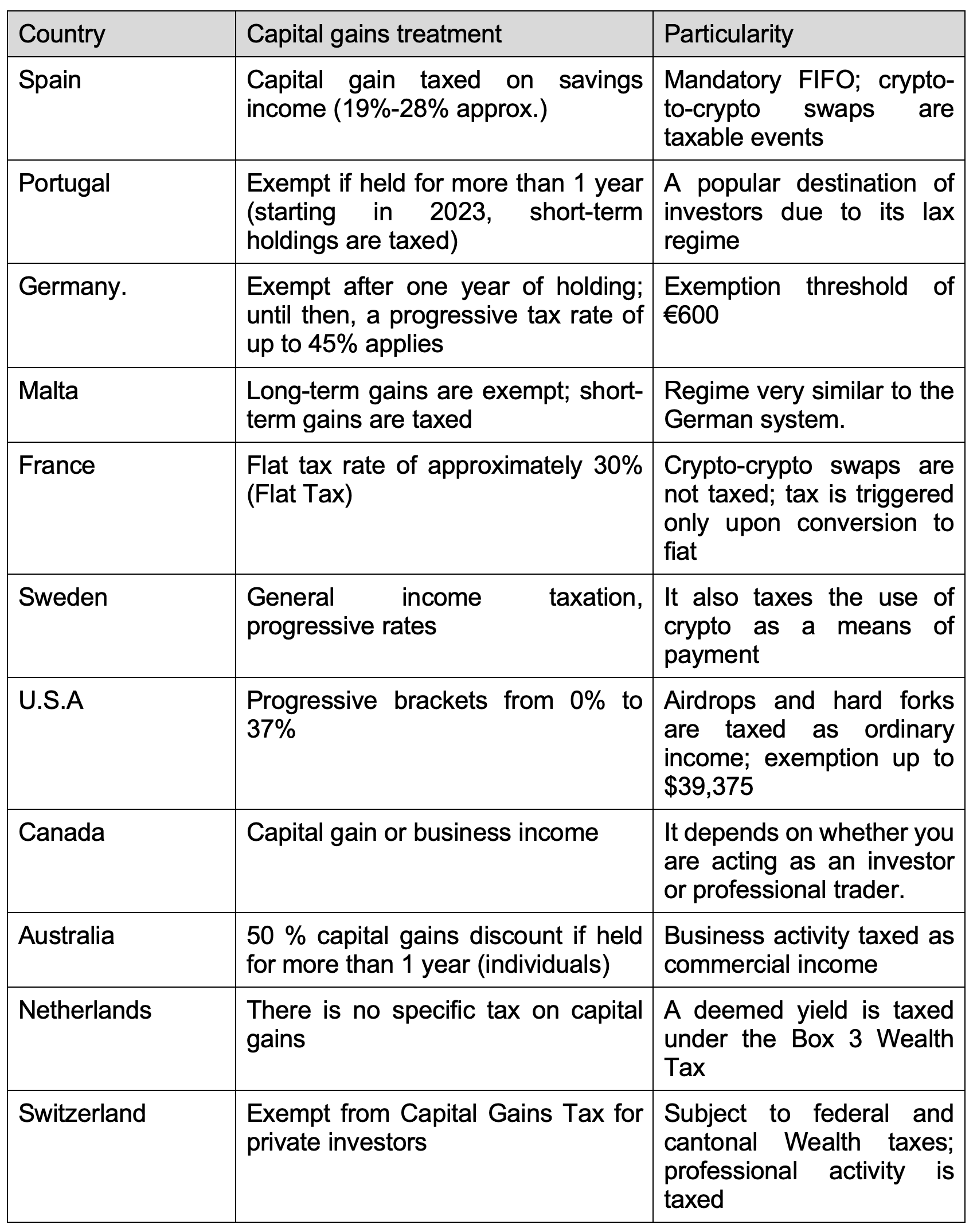
This heterogeneity is not merely anecdotal, as it generates real risks of both double taxation—when two states claim taxing rights over the same income under conflicting sourcing criteria—and double non-taxation. Furthermore, it hinders tax planning for cross-border operations and discourages the use of crypto-assets as an international means of payment.
Beyond the current state of the issue, it is worth noting several pending challenges that are expected to mark the evolution of direct taxation of crypto assets in the coming years.
The absence of specific laws will force many countries to continue resolving increasingly complex scenarios (Such as DeFi, hybrid tokens, and tokenized real-world assets) through binding rulings. This carries a risk of fragmentation and responses that are not always consistent with one other.
On the other hand, the lack of mention of crypto-assets in double taxation treaties requires an interpretative exercise by analogy, leaving a significant margin of discretion for each Contracting State.
Regarding the upcoming impact that the OECD’s Crypto-Asset Reporting Framework (CARF) and the EU’s DAC8 Directive will have[2], whose first information exchange is planned to begin in 2027, these frameworks are expected to boost substantially on voluntary compliance By forcing exchanges, brokers, and certain decentralized platforms to identify their users and report transactions, they will vastly increase the data available to tax administrations, thereby reducing the rate of under-reporting that has characterized this market so far.
It is also worth highlighting the future role that courts will play beyond mere administrative doctrine, given that tax-related jurisprudence on crypto-assets remains scarce to date.
At the international level, the absence of a consensus perpetuates a mosaic of national solutions that, while responding to legitimate tax policy objectives, complicate cross-border activity and open the door to tax arbitrage , with investors moving towards more favorable taxation jurisdictions.
That is why we agree with Raúl Zambrano in his contribution to this blog, which emphasizes the need for greater cooperation between tax administrations[3].
In short, managing crypto-assets presents a monumental challenge for tax administrations. As demonstrated in this post, this difficulty is further compounded by the complexities of applying direct taxation to highly diverse business models.[4].
Referencias:
[1]Jiménez, J. P., & Podesta, A. (2025). Taxation of crypto-assets in Latin American and Caribbean countries (Working Paper No. DT-07-2025). Inter-American Center of Tax Administrations CIAT https://www.ciat.org
[2] Collosa, Alfredo “CARF, MiCA, DAC 8 and the Travel Rule move towards greater transparency in the crypto-asset market” https://www.ciat.org/carf-mica-dac-8-y-la-travel-rule-avanzan-hacia-mayor-transparencia-en-el-mercado-de-criptoactivos/
[3] Zambrano Raul, A Vampire Story (VI) https://www.ciat.org/ciatblog-una-historia-de-vampiros-vi/
[4] Collosa, Alfredo What are the Tax Administrations doing to manage crypto assets? https://www.ciat.org/ciatorg-que-estan-haciendo-las-administraciones-tributarias-para-gestionar-los-criptoactivos/
2,178 total views, 4 views today