
The DNA Evolution of Tax Administrations and the Second Technology Conference of CIAT
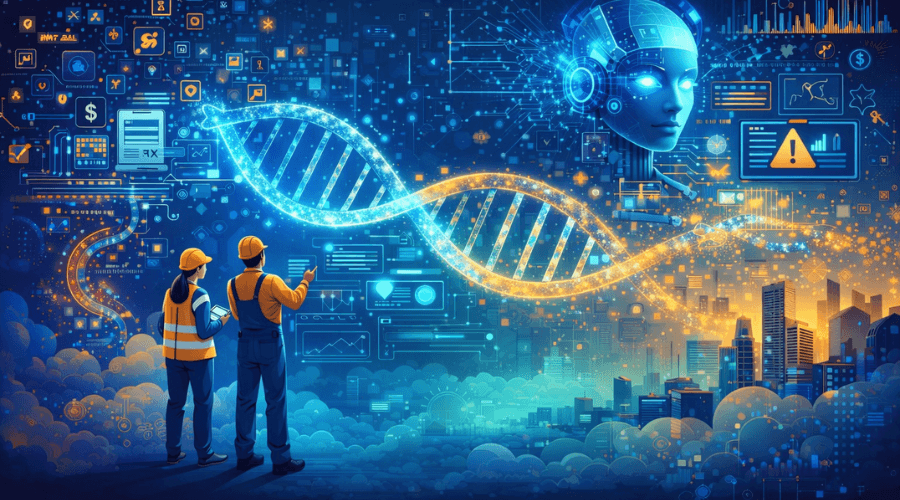
Today, tax administrations can process millions of digital transactions in a matter of seconds. Meanwhile, the dynamics of compliance and tax planning are evolving with increasing sophistication. However, many systems still operate under logic designed for a much more predictable environment.
This raises an inevitable question: Can a model designed to react to the past respond to an environment that changes in real time?
If we look at the evolution of human beings, one constant element explains our ability to adapt: DNA. DNA is not static; it mutates, adjusts, and responds to environmental pressures. Thanks to this, humanity has moved from basic survival to constructing complex and interconnected systems.
Tax administrations face a similar process.
For decades, their institutional “DNA” was designed for a more predictable world with local economies, a lower volume of information and relatively simple structures. Under that design, monitoring was essentially reactive. Breaches were detected and corrected after the fact by reviewing the past. It was a functional, albeit limited, model.
However, the environment has changed radically. The digitalization of the economy, the speed of transactions and the sophistication of compliance behaviors have created new evolutionary pressures. In this new ecosystem, a DNA based solely on reaction is insufficient.
As in any evolutionary process, the answer has been adaptation.
The first significant change to this DNA is incorporating risk management as a structural principle. Rather than treating all taxpayers the same, administrations are beginning to segment, prioritize, and focus their resources based on risk. This “mutation” optimizes efforts by concentrating on areas of greater impact.
However, risk management alone does not transform the system. In order to work, it requires a nervous system that can process information in real time. This is where technological solutions for tax administrations come in.
Advanced analytics platforms, interoperability systems between entities and automation tools enable the integration of large volumes of data and transform them into useful information. It is as if the Tax Administration’s DNA has developed new neural connections, capable of interpreting complex signals and reacting more accurately.
In practice, this is already happening. Some administrations use analytical models that identify behavioral patterns and detect risks before they materialize. This changes the logic of action completely: instead of auditing late, we intervene early, reducing costs and improving the control effectiveness.
However, the real turning point – the one that completely redefines the field- is represented by artificial intelligence.
Unlike traditional tools, artificial intelligence can analyze more than just what has already happened. It learns, identifies hidden patterns and, most importantly, anticipates behaviors. It marks the transition from reactive to predictive DNA.
However, as with all evolution, this change does not occur in isolation.
It requires environments where different factors interact, where new capabilities are assessed and where “mutations” can be established. These spaces allow evolution to happen and accelerate.
The development of this new tax DNA requires spaces for exchange, experimentation, and collective learning. Without these environments, evolution becomes fragmented; with them, however, evolution becomes articulated and strengthened.
In this context, the Second CIAT Technology Meeting, returning after a decade, is one of the spaces where this new DNA begins to be defined. It is more than an event; it is a point of convergence where private sector actors share experiences, contrast approaches, and discuss solutions for tax administrations.
Designed as a technical space, the meeting is oriented toward the exchange of practices and tools, moving away from commercial approaches. The agenda incorporates essential topics such as artificial intelligence, data analysis, cybersecurity, cloud services, tax intelligence, digital identity, and other innovative solutions that promote institutional modernization.
The meeting is organized into three sessions that reflect the main components of this evolutionary process. The first session focuses on solutions for tax and revenue management and addresses process optimization and the incorporation of technologies that strengthen operational efficiency.
The second session is dedicated to tax compliance control and risk management. It delves into the strategic use of information to anticipate behaviors, segment taxpayers, and improve control effectiveness.
The third session focuses on artificial intelligence in tax administrations and explores machine learning and predictive analytics tools that transform decision-making and move us toward truly anticipatory models.
The overarching objective of the meeting is to provide a platform for sharing practical experiences and applied solutions where innovation translates into tangible capabilities.
In these environments, ideas are presented, discussed, adapted, and evolved. Participating companies and specialists function as facilitators of this transformation process, strengthening institutional capacities.
The clear challenge going forward is to evolve with balance. We must integrate new technologies without losing sight of transparency, information security, and trust in the tax system.
As with biological processes, success is not defined by isolated innovation, but by the ability to adapt continuously in the right environments.
It is precisely in these spaces where the DNA of tax administrations is built and changed.
3,574 total views, 2 views today