
Global environmental taxation and its issues for Latin America
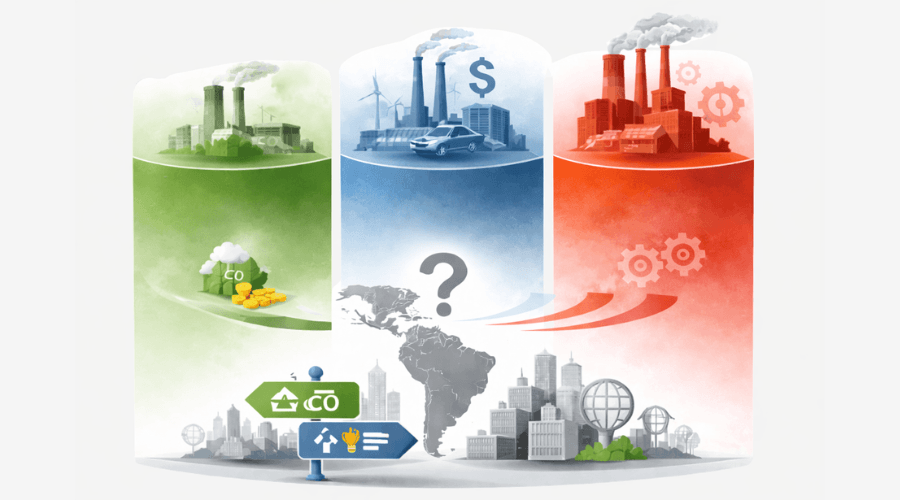
The ecological transition is progressing in the world at various speeds. In some countries, environmental taxation serves as a tool to correct market failures and accelerate decarbonization. In others, however, the fiscal intervention takes the form of incentives aimed at stimulating technological change without directly penalizing carbon-intensive industries. And then, some opt for hybrid models, where taxes, regulations and state planning coexist under a more pragmatic logic.
In this paper, three main approaches will be briefly analyzed: the European, the American and the Chinese. Beyond their differences, they all converge on the same objective — to reduce emissions, modernize productive sectors and respond to the climate emergency — but they do so through profoundly different fiscal strategies.
These divergences not only condition global competitiveness but also frame the context in which LAC countries must define their own path forward. Should they tax, should they incentivize, or combine both approaches? Which model is viable in economies with less fiscal space? And what can the ecological transition imply for your country’s international insertion?
Europe: the regulatory laboratory for green taxation
The European Union has established itself as the jurisdiction that has most ambitiously integrated taxation into its climate strategy. The European Green Deal and the commitments derived from the Paris Agreement have pushed the EU towards an approach that prioritizes environmental taxes, reinforcing the historic polluter-pays principle.
This approach is implemented through:
- -High energy taxes, among the world’s highest.
- -CO₂ taxes in many Member States.
- -Progressive fossil fuel phase-out taxes (e.g., Denmark’s model).
- -The European Emission Trading System (EU-ETS), one of the star instruments for setting a price on carbon.
- -Growing circular taxation: taxes on single-use plastics, fees for landfilling and incineration, and extended producer responsibility measures.
To this, we can add the Carbon Border Adjustment Mechanism (CBAM), which aims to avoid the delocalization of emissions by imposing a price on the carbon contained in imported products. With this instrument, Europe exports its fiscal logic beyond its borders and transforms international trade.
The other side of this ambition is clear: higher costs for industry, the risk of losing competitiveness, and a more challenging transition for consumers and businesses. Europe exercises undisputed regulatory leadership, but at the same time it is navigating delicate economic waters, especially in the face of global competitors with much less stringent tax models, as well as shifting landscapes and global conflicts that could affect the price of certain resources.
The United States: Transition as an economic opportunity
In contrast to the EU, the United States lacks a federal carbon tax or emission trading scheme. Instead, it centers its climate policy almost exclusively on massive tax incentives.
The American logic starts from a different logic: It trusts that the industry responds better to positive stimuli than to penalties. Consequently, the key mechanisms are:
- • Production Tax Credits (PTC), rewarding renewable energy generation.
- • Investment Tax Credits (ITC), slashing clean tech investment costs.
- • The Inflation Reduction Act (IRA), approved in 2022, is still the largest climate fiscal support package in the country’s history, despite targeted reforms (2025).
The IRA has transformed America’s energy and manufacturing landscape. It has attracted global investments towards battery factories, green hydrogen, carbon capture, and electric vehicles. Its design also seeks to reorient the global supply chain towards American soil: an industrial strategy as well as an environmental one.
However, this model presents challenges. The incentives have turned out to be more expensive than expected, and there is uncertainty about their future continuity in a country with volatile political cycles. In addition, the benefits of the IRA are not evenly distributed: some areas of the country capture most of the investment, while others are left on the sidelines.
China: fiscal pragmatism in a hybrid model
China, the world’s leading CO₂ emitter, has rapidly evolved towards a more sophisticated environmental policy. Its model combines:
- • Selective environmental taxes, such as the Environmental Protection Tax (2018).
- • Strict administrative regulations.
- • Targeted subsidies to strategic sectors: solar panels, wind turbines, batteries, and electric vehicles.
- • A national emissions market, operational since 2021, and already the largest by volume of emissions covered.
Unlike the EU, China does not focus solely on carbon; and unlike the United States, it does not leave the process to private initiative. Its transition is intrinsically linked to state planning, aligned with national goals such as carbon neutrality by 2060.
The result is a hybrid model that has allowed China to reduce energy intensity without losing industrial competitiveness. In fact, the more moderate fiscal pressure, combined with subsidies and state control, has favored the country to lead sectors such as the manufacture of solar panels, batteries, and electric vehicles.
China thus shows that environmental taxation can be articulated not only as a correction mechanism, but as a lever for geo-economic projection.
Three models, one global dashboard
The three approaches differ not only in design, but also in philosophy:
- • Europe “punishes”: its strategy is to raise the cost of polluting.
- • The United States “rewards”: it turns the ecological transition into an industrial opportunity.
- • China “directs”: it combines instruments with a logic of strategic planning and state control.
What can all this mean for Latin America?
The analysis of these three models inevitably opens the question: what path should Latin America follow in its own ecological transition?
The region is facing a number of structural challenges:
- • A limited and dispersed fiscal space, which makes it difficult to implement massive incentives.
- • A strong dependence on extractive sectors, which would be especially sensitive to mechanisms such as the European CBAM.
- • A heterogeneous regulatory mosaic, with countries advancing carbon taxes (Chile 2022, Colombia’s 2023) versus others, where environmental taxation remains incipient.
- • China’s growing economic presence or the United States’ continued influence, which could affect the type of fiscal and energy policies adopted by some countries.
- • The need to attract green investment, which requires regulatory stability and coherent policies.
In this context, copying the European model could be too expensive; reproducing the American one, fiscally unsustainable; and emulating the Chinese one, institutionally difficult given the administrative heterogeneity and diversity of States with distinguished economic interests.
Latin America therefore needs its own model, which combines, for example, gradual fiscal instruments, selective incentives for strategic sectors, regional cooperation and a long-term vision that integrates sustainability with economic development.
Conclusions
Environmental taxation has become a key tool of global economic policy. Europe, the United States and China have chosen different paths to face the climate challenge: one based on strict levies, another on massive incentives and a third on a pragmatic balance between the two.
Far from being just technical debates, these decisions are redefining international competitiveness and raise urgent questions for regions such as Latin America, which must design policies that are environmentally responsible, economically viable and socially just.
The challenge for Latin America is not to align itself with a single model, but to learn from all three to build its own path — a model that combines climate ambition with economic realism, and that allows it to integrate the global ecological transition without being left behind.
3,138 total views, 1 views today