
16 Tax Measures to Boost Business Dynamism

Boosting business dynamism is a priority for countries, especially when their economies are growing below their potential. Under such circumstances, the ability to create formal jobs, reduce poverty, and generate the tax revenue needed to finance essential public goods and services is diminished. Therefore, in this context, it is essential for governments to implement coordinated public policy and administrative measures to strengthen the business ecosystem.
Among the factors influencing business dynamism is the tax system within which companies must operate. Along these lines, the Organization for Economic Co-operation and Development (OECD), in its study Corporate Income Taxation and Business Dynamism, published in May 2026 [1], explains how the design of the corporate income tax system can influence the entry, growth, and exit of businesses.
For example, the aforementioned publication notes that: (i) reducing effective tax rates can encourage the entry of small and young companies, although the magnitude of these effects is not yet clear; (ii) market exit is influenced more by market forces than by changes in taxation; and (iii) high compliance costs for small, medium-sized, and young firms may limit their entry.
In a previous study commissioned by the G20 Finance Ministers from the OECD [2], which includes an analysis of the effects of fiscal uncertainty, it was found that investment and location decisions are determined by numerous factors, with the five most influential being: corruption, political stability, the general tax environment, current and expected macroeconomic conditions in a country, and labor costs. This reveals that taxation plays a significantly greater role than is commonly assumed, although this assessment could be influenced by the high percentage of corporate tax directors who participated in the study.
Although taxation is not usually the main determinant of business investment decisions, as it is outweighed by other factors, international evidence shows that it constitutes one of the most important economic factors.
Following the same line of thinking regarding the influence of the tax system on business decisions, the Business Ready (B-READY) project developed by the World Bank (an initiative that replaces and improves the Doing Business Report) provides a quantitative assessment of the business environment on an annual basis, with an expanding country coverage. Its measurements consider the level of development of certain aspects of tax policy and tax administration, through consultations with experts and business surveys.
In the field of taxation, B-READY assesses the quality of regulation covering both the legal framework and the implementation of legal requirements; tax administration, through the evaluation of public services provided related to taxes; and the practical implementation of tax regulations.
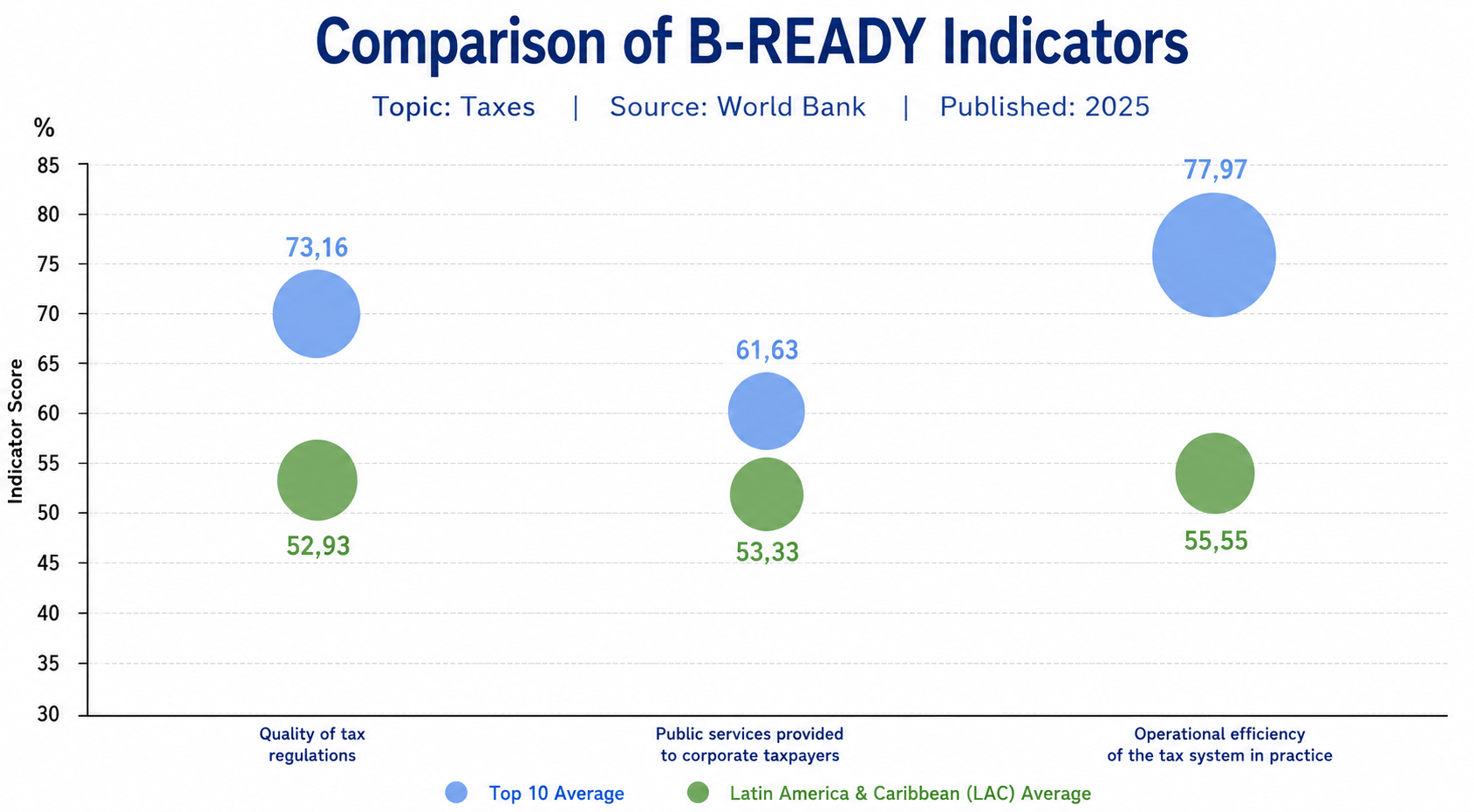
As can be seen in the graph at the end of the document, the average degree of development of the eight Latin American and Caribbean (LAC) countries participating in the project shows a significant gap for improvement in each concept compared to the results achieved by the ten highest-performing countries [3]. This highlights the need to undertake reforms that allow our countries to achieve tax conditions similar to those present in more developed economies, a matter of particular importance given that markets for goods, services and capital are facing progressively fewer geographic barriers.
According to the scope of the project, the main shortcomings in tax systems that prevent LAC countries from providing a more favorable business environment and, therefore, becoming more competitive, are found in the quality of tax regulations, the effectiveness of public services provided to corporate taxpayers, and operational efficiency.
Considering the results presented in 2025 and the international experience, it is possible to list the main tax administrations and tax policy measures that should be undertaken by the tax authorities to ensure better tax conditions for economic growth, as described below:
- Increase the transparency of internal criteria and positions that serve as the basis for decision-making in administrative acts. In many cases, tax administrations have a position on how a tax obligation should be fulfilled, but this position is not known to taxpayers.
- Provide public access to decisions issued in tax appeal proceedings at all levels, while protecting confidential information. Although several jurisdictions make such information available, in many cases it does not include the decisions issued by first-level administrative bodies.
- Expand the circumstances in which binding public rulings must be issued to increase the predictability of the system. There are often only a limited number of situations in which binding rulings can be issued, typically without considering criteria such as tax relevance or frequency of occurrence
- Expand the participation of private sector stakeholders on the proposed changes in tax legislation and regulation before their implementation. This will allow the authorities to have greater context and visibility of the impact on the market generated by the changes, as well as greater adaptation of companies.
- Simplify the accounting records requirements in the case of small businesses, in order to reduce compliance costs. Obligations to maintain or provide information should be proportionate to the size and complexity of the operations, avoiding duplication of requirements.
- Introduce a minimum turnover threshold for mandatory VAT registration or registration under another consumption-based tax or increase awareness of existing thresholds. In some cases, such thresholds are already present in simplified tax regimes, but lack of awareness may limit the entry of new small businesses
- Adopt high-quality standards for digital platforms available to taxpayers, with internal and external audits, the results of which and response plans should be public. Other important features include a taxpayer-segmented approach and integration with business systems.
- Expand pre-filled tax return services to include at least value-added tax (VAT), corporate income tax, and payroll taxes. Although tax administrations have made progress in this area, coverage and taxpayer acceptance remain limited.
- Continuously update tax collection systems in order to enable the payment of tax obligations through the growing range of financial services and payment instruments available. This is especially relevant given the expansion of cross-border transactions.
- Integrate the procedures for creating and updating company data at the state level, in order to avoid duplicative procedures, multiple information requirements and processing costs. This requires an interoperability platform and the use of a single digital identity.
- Establish periodic processes of accountability to society that contemplate at least: the fulfillment of institutional objectives, levels of perception about the tax system, assessment of compliance with the conduct of public officials and levels of attention to complaints and reports.
- Formulate and publish an annual audit plan that sets out the technical criteria that support the main aspects that will be the subject of tax control, the deployment of the efforts of the tax administrations, and the expected and achieved results in terms of improving compliance.
- Simplify administrative procedures and reduce the frequency of information requests made. Although tax administrations seek to address this point with digital tools, in many cases they fail to measure the impact of the solutions and these end up being more expensive than the original approach.
- Reduce the time for audits and dispute resolution, in order to provide the system with greater tax certainty. When procedures are completed over extended periods, they generate uncertainty regarding the position that companies should adopt in future operations and an increase in new disputes.
- Evaluate the effective tax rate of corporate income tax, in order to ensure that it is progressive. This measure goes beyond having different rates or regimes, since it includes reviewing whether the percentage of each segment effectively allows one to affirm that there is a progressive tax system.
- Enable effective dispute prevention mechanisms (advance pricing agreements, settlement agreements, etc.) and establish effective two-ways communication channels with taxpayers with complex transactions. In many cases these are measures present in legislation but not implemented in practice.
The incorporation of these measures should not be interpreted as a limitation of the powers of the tax administrations (for example, audit and control). On the contrary, these powers remain indispensable to guarantee the integrity and fairness of the tax system, but their exercise must respond, among others, to the principles of proportionality, efficiency, and substantive truth, which allows for a more constructive tax relationship, not only in terms of collection but also in aspects related to economic growth.
On the other hand, in many cases it could be thought that the contribution of the tax system to business dynamism could come only from the granting of tax benefits; however, the measures listed, based on theoretical and practical elements, show us that the role of tax administrations has a lot to do with it. In fact, the International Monetary Fund in its study “Raising Tax Revenue: How to Get More from Tax Administrations?”, estimates that the greater efficiency of revenue authorities can contribute to approximately three percentage points of GDP in additional tax revenue [4].
The approach proposed, regarding the importance of tax management, acquires greater relevance in the current context of the implementation of the global minimum tax promoted by the OECD, which, by establishing a minimum effective rate for large multinational groups, could limit the effects of certain tax exemptions. Consequently, the promotion of the measures listed and dependent on the work of the tax administrations are especially relevant in the current tax environment.
In general terms, tax administration must ensure efficiency, transparency, and credibility. Achieving its objectives with the lowest possible compliance costs, taking advantage of technology and synergies; communicating the changes and positions assumed regarding tax compliance in a timely and adequate manner; and being consistent in its technical action, with a high level of specialization, based on the legal framework and respect for the rights of taxpayers, thereby contributing to legal certainty.
References:
[1] Available at: https://www.oecd.org/en/publications/corporate-income-taxation-and-business-dynamism_59a40a50-en.html
[3] Data available at: https://www.worldbank.org/en/businessready/topic/taxation
[4] Available at: https://www.imf.org/en/publications/wp/issues/2020/07/24/raising-tax-revenue-how-to-get-more-from-tax-administrations-49584
2,122 total views, 1 views today