
Digital Economy Compliance-DEC

Modernization and Cooperation for the Taxation Challenges in the Digital Economy
DEC System (Digital Economy Compliance)
CIAT’s technological solution for a public good to address the challenges of the digital economy
Main advantages of DEC:
• Highly customizable to adapt to the specific characteristics and regulations of each jurisdiction.
• Free for tax administrations that implement it.
• Tested and operational: installed in seven tax administrations internationally.


What is the DEC System?
A Strategic Platform for Tax Administrations

Main objective:To provide an effective tool for managing the taxation of companies without physical representation in the jurisdiction.

Simplified Process: Designed to facilitate registration, tax returns, and tax payments by foreign digital providers.

International Cooperation: The development involved the collaboration of experts from various jurisdictions.

Global Reach: The model has proven its effectiveness with adoption in countries across the Americas, Africa, and Asia, and a new multi-jurisdiction version is under development for Oceania.
Benefits of Taxing the Digital Economy
Taxing the digital economy is a complex issue, but it has several key benefits that seek to adapt traditional tax systems to modern business models:
Level Playing Field: Seeks to level the fiscal playing field between multinational digital companies (which can often minimize their taxes in certain jurisdictions by taking advantage of their lack of physical presence) and traditional or local companies, which do have a physical presence and are subject to local tax rules.
Fair Taxation: Allows countries to tax a portion of the profits or revenues generated in their territory, even if the company does not have a traditional “physical presence.” This is based on the principle that value is created where the users and the market are located.
New Sources of Revenue: By taxing activities that previously escaped the traditional system (such as online advertising sales, digital intermediation services, and user data sales), governments gain a new and growing source of revenue.
Public Service Financing: These additional revenues can be used to strengthen public finances and essential services such as education, health, and infrastructure.
Response to New Business Models: Current tax systems were designed in a non-digital era. Taxing the digital economy is an effort to modernize the rules and ensure that they remain effective and fair in the context of globalization and digitization.
Countering tax Base Erosion and Profit Shifting (BEPS): Many of these measures are aligned with international efforts (such as the OECD’s BEPS Project) to limit tax evasion and avoidance by multinational companies, preventing them from shifting their profits to low- or no-tax jurisdictions.
Regulatory clarity: Establishing a specific tax framework for the digital economy provides greater clarity and legal certainty for both taxpayers and tax administrations.
Reducing Tax Avoidance: Closing loopholes that allow digital companies to artificially reduce their tax burden promotes greater effectiveness and fairness in tax collection.
In summary, the main objective is to ensure that taxation keeps pace with value creation in the digital economy, promoting fairness, revenue adequacy, and the modernization of tax systems.
Legislation
The Essential Synergy between Technology and Legislation
System Structure and Modules
Visual Flow Diagram
Main Modules and Functionalities: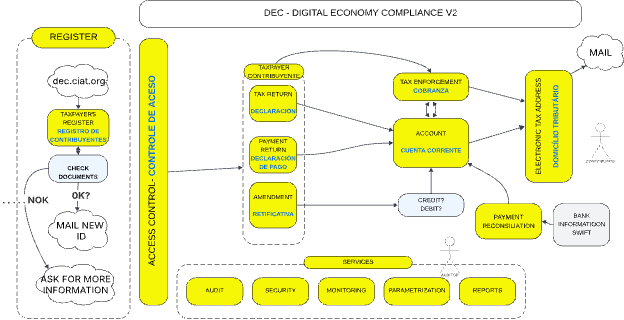
The DEC V2 system consists of interconnected modules that manage the entire taxpayer compliance cycle. The key components are:
Taxpayer Registration: Initial process of registration and document verification.
Tax Return: Submission of tax returns.
Payment Return: Registration and submission of payment information.
Amendment: Module for correcting or altering submitted returns.
Current Account: Centralizes information on returns, payments, and collections.
Enforced tax collection: Module for the enforcement and administration of tax debts.
Electronic Tax Address: Official channel of communication with taxpayers.
Access Control: Manages access permissions throughout the system.
Audit: Tools for auditing logs and operations.
Security: System security layer.
Monitoring: Tracking of system activities and performance.
Parametrization: Configurations and adjustments to system rules.
Reports: Module for extracting management and operational reports.
Documentation and Resources
Links to Manuals and Demonstration Videos
Manuals and Guides:
Quick Guide V2:
Español (ES): https://biblioteca.ciat.org/opac/book/5826
Inglés (EN):https://biblioteca.ciat.org/opac/book/5827
Administrator Manual V2:
Español (ES): https://biblioteca.ciat.org/opac/book/5823
Inglés (EN): https://biblioteca.ciat.org/opac/book/5824
Taxpayer Manual V2:
Español (ES): https://biblioteca.ciat.org/opac/book/5790
Inglés (EN): https://biblioteca.ciat.org/opac/book/5825
Handbook:
Español (ES): https://biblioteca.ciat.org/opac/book/5826
Inglés (EN): https://biblioteca.ciat.org/opac/book/5827
Demonstration Videos:
Register: https://www.youtube.com/watch?v=S2MAQf36-6M
Declaration: https://www.youtube.com/watch?v=JsSXQRc5eTI
Administration : https://www.youtube.com/watch?v=pJKco5WNxww
Control (Control): https://www.youtube.com/watch?v=E6m4fEC7RNc&t=89s
Access to the system
Explore the DEC Platform
Access our test environment to familiarize yourself with the system and explore all its features.
Access to DEC
1,385 total views, 4 views today