
CIAT’s technical assistance in a nutshell

Sheldon Cohen, the first chairman of the CIAT Executive Council , stated in an interview on the occasion of the 50th General Assembly: “Once you have some cooperation, it’s easier to have more cooperation.” It is worth paraphrasing today to say that, with a little technical support, it is also easier to generate more technical support.
Unlike our planet, which does not begin or end at the poles or at meridian zero, the history of CIAT’s technical assistance can be placed with reasonable precision in time.
Its first steps date back to 1977, when Germany decided to bet on Latin America. Spain and France joined this effort in 1982, with their permanent missions. At that time, a technical cooperation officer was appointed to the Executive Secretariat: Jorge Cosulich, one of the authors of this text. He was responsible for directing CIAT’s first technical assistance project, related to information technologies — then simply called “informatics” —, in which two Brazilian consultants and SERPRO officials participated, pioneers in venturing into the still uncharted waters of consulting for tax administrations in Latin America and the Caribbean. One of them, the first of the CIAT consultants, Antonio Seco, is also a co-author of these lines.
This initial experience was followed by the RUC/CC project, which was funded by the Inter-American Development Bank (IDB), and marked the beginning of a long-standing relationship of mutual cooperation—sometimes explicit and sometimes tacit, but always meaningful. During that period, under the leadership of Luisa Rains as head of the IDB’s Fiscal Division, the IDB and CIAT provided technical assistance to countries in Central and South America. Various experts joined the Executive Secretariat during those years, including Jorge Eduardo Corradine, after whom our library is named, as well as project managers Celso Mora and Francisco Beiner, who remained associated with CIAT until 2025. We would especially like to remember Marcio Gomes da Cruz for his contribution to consolidating these efforts at both CIAT and the IDB. Another of the authors, Raul Zambrano, also participated in his first consultancy with CIAT during that period, in 1992.
As early as 2001, when Jorge Cosulich was serving as Executive Secretary, the Executive Secretariat’s project management team first recruited Paulo Sergio dos Santos, followed by Nelson Gutiérrez as Director of Operations. Márcio Verdi, another of the authors of this post, later joined the team. As Executive Secretary, Márcio Verdi gave new impetus to technical assistance at CIAT, entrusting Raúl with leading these processes. Jorge and Antonio have continued to support these processes in their roles as consultants.
Throughout these decades, at different times, the five of us have been, sometimes, protagonists and, other times, privileged witnesses of process improvement projects, systems implementation, strategic redirection, organizational mergers, tax reforms, institutional strengthening, capacity development, and many other forms of cooperation. This work has been conducted in all the CIAT member countries of Latin America and the Caribbean, with at least one intervention in each of them. This is how we accompany the creation and consolidation of institutions such as the SUNAT, the SENIAT, the SRI, the SAT or the SAR, acronyms that today identify themselves, without having to name the country. We also participate in the improvement and automatization of processes ranging from the cadastre to the tax current account, from risk management to auditing, from taxpayer assistance to conflict prevention, and from the processing of paper declarations to national electronic invoicing systems and pre-filled declarations.
It is enough to observe the fiscal files to note that, since 1990, the tax burden in the region has registered a remarkable increase of seven points, equivalent to about 50%. Or the importance of indicators such as the cost of collection, 0.95 cents per dollar; or the level of technological maturity of tax administrations, where the countries of Latin America and the Caribbean reach 0.57, close to 0.59 of all member countries, and much higher than the world average.
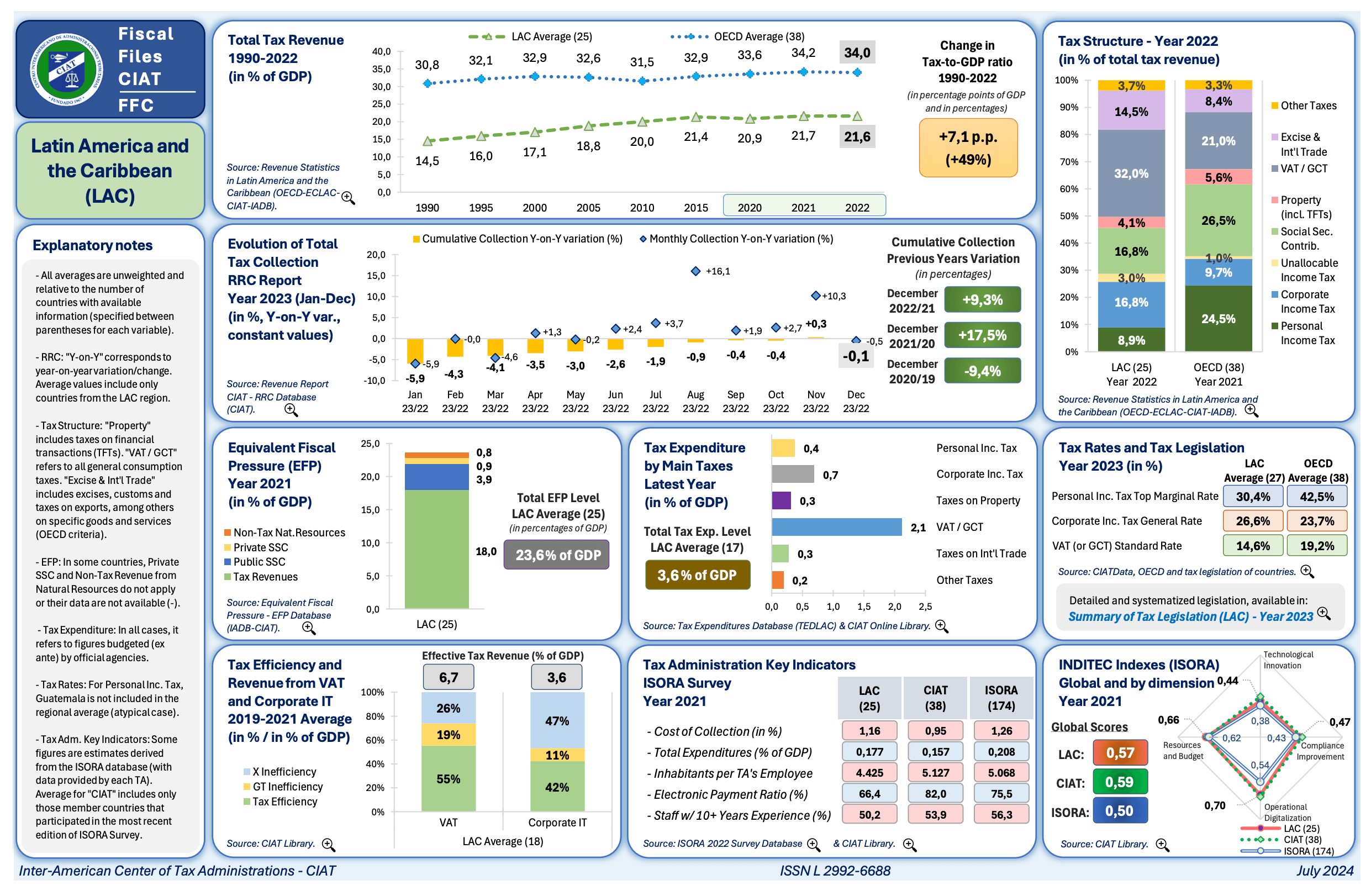
This improvement cannot be attributed to a single factor. The elements that explain it are multiple: the professionalization of human resources, institutional strengthening, the accompaniment of coherent regulatory frameworks and the maturation of the administrations themselves, among others. But we like to think that, in a small part of that improvement, in that modest “nutshell,” CIAT’s technical assistance has also contributed.
A lot of people have been involved in that process. It is impossible to name them all without incurring in unintentional omissions, but it is fair to mention at least the colleagues of the Executive Secretariat who today continue to act in technical assistance tasks directly: Gonzalo Arias, the last of the authors of this post, Alejandro Juárez and Santiago Díaz de Sarralde, joined by Vinicius Freitas, David Borja, Julia Fontaine, Décio Carretta, Maureen Pérez, Tomás Torres, César Trejos, Anarella Calderoni, Fransheska López and David Jerezano. Along with them, the heads of the missions to CIAT who participated directly in the projects deserve special recognition, not only as experts, but above all as colleagues who worked side by side with the administrations: Daniel Verneth, from France; Hans Fuchs, from Germany; Stefano Gesuelli and Antonio D’Agostino, from Italy; and, from Spain, Rafael Salinas, Raúl Junquera, Luis Cremades, Juan Redondo and Mariano Rojo.
They are joined by an extensive network of consultants that, over more than four decades, has been decisive for the development of these initiatives. Coming from different latitudes, with different languages, backgrounds, and specialties, they have enriched the work of CIAT and its member countries. Some are no longer with us, such as Francisco da Cunha, remembered for having conceived in the nineties that great effort that gave rise to Tax Solutions, a tax management software that supported various administrations for more than twenty years.
In addition to numerous colleagues from the IDB, later led by Vicente Fretes, Emilio Pineda, and Marta Ruiz, we were also accompanied on this tour by the FAD of the International Monetary Fund and its regional centers, CAPTAC and CARTAC. And, in the last fifteen years, international cooperation, led at CIAT by Gonzalo Arias, the last of the authors of this post, has been reinforced by key donors such as SECO, GIZ, NORAD, AECID, EUROsociAL and the Gates Foundation; which have allowed to bring more than 1500 weeks of technical assistance at no cost to several of our countries, particularly those with less relative development, and to build public goods that have promoted technical assistance actions.
Taking the inspiration from the title of some famous book, we believe that this short text, as small as a walnut, wants to be both a story and a tribute. An account of the history of the technical assistance that CIAT has developed for almost fifty years, and a tribute to all the people and institutions that made it possible. In all this time, beyond the technical, we have learned and transmitted, from generation to generation, within CIAT, that there are no “lone rangers,” that the coordination of actions with partners and networks of experts is capitalized and that the human factor underlying these technical assistance actions will not be replaced, at least for now, by artificial intelligence.
It is appropriate to recognize this now, as we approach the celebration of the 60th General Assembly of CIAT and say with joy and aloud: Happy anniversary.
Greetings and Godspeed.
3,695 total views, 4 views today